Hundreds of college newspapers publish at universities that don’t offer journalism majors — and that’s no problem for the students.
By Sophie Levenson
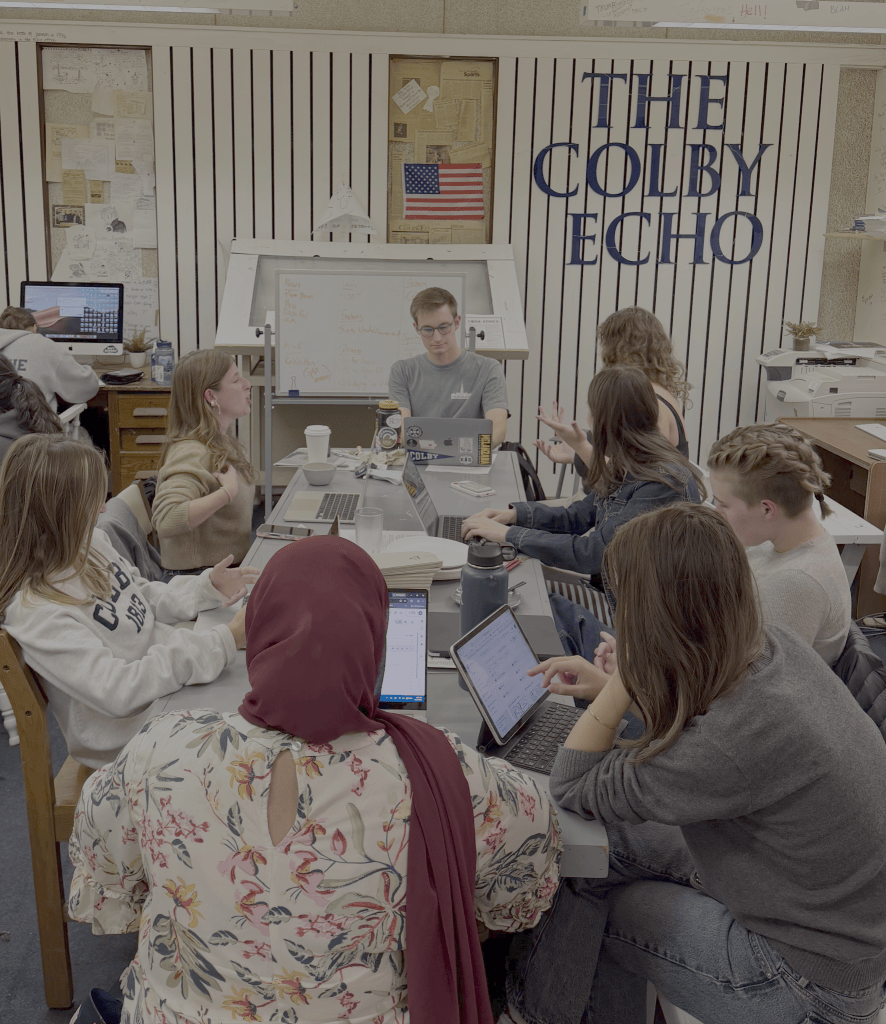
Just before 7 p.m. every Monday of his academic year, Elias Kemp walks to The Colby Echo newsroom and settles in for a long night of editing.
In January, Kemp, now a senior, started as co-editor-in-chief of The Echo, the independent student newspaper at Colby College in Waterville, Maine. The Echo prioritizes its print edition, which comes out weekly during school. Monday is production night, when Kemp and his staff edit articles and lay out the paper for Thursday distribution. The Echo hasn’t found anyone in Colby’s 2,400-person student body to take the distributor position, so Kemp wakes up at 5:30 every Thursday morning to fill the newsstands himself.
Colby, a small, elite college, boasts a liberal arts curriculum — and no journalism program.
Nobody in The Echo’s newsroom is a journalism major or minor; most of them have never even taken a class in the subject. But by the end of the night, they will have created a newspaper that’s ready to print.
Of the roughly 1,100 college newspapers that exist in the United States, fewer than half have academic journalism programs on campus. U.S. News & World Report lists 330 results for a search of schools that offer journalism degrees; the National Center for Education Statistics lists 450 (and there are about 120 accredited journalism programs in the nation). Many of the nation’s most prominent and decorated student media operations — like UCLA’s Daily Bruin, The Michigan Daily, The Harvard Crimson and The Cornell Daily Sun — operate at universities that lack formal journalism education departments.
Student journalists on those campuses don’t mind. In fact, many spoke about finding a certain freedom in figuring things out on their own.
“With enough attention and self-motivation, you can teach yourself how to become a decent journalist,” Kemp said.
On-the-job training
Of course, there are things that student journalists miss out on when they can’t take classes on their craft.
Jorie Fawcett, the 2024 editor-in-chief of The Hustler, Vanderbilt’s independent student newspaper, sometimes wondered where the paper’s conventions came from. If a new writer asked a question during training about why something was done a certain way, Fawcett often came up short.
“I never really knew the answer,” she said. “Because someone had just told me that that’s how we do it, and then I was passing that along … It was just replication.”
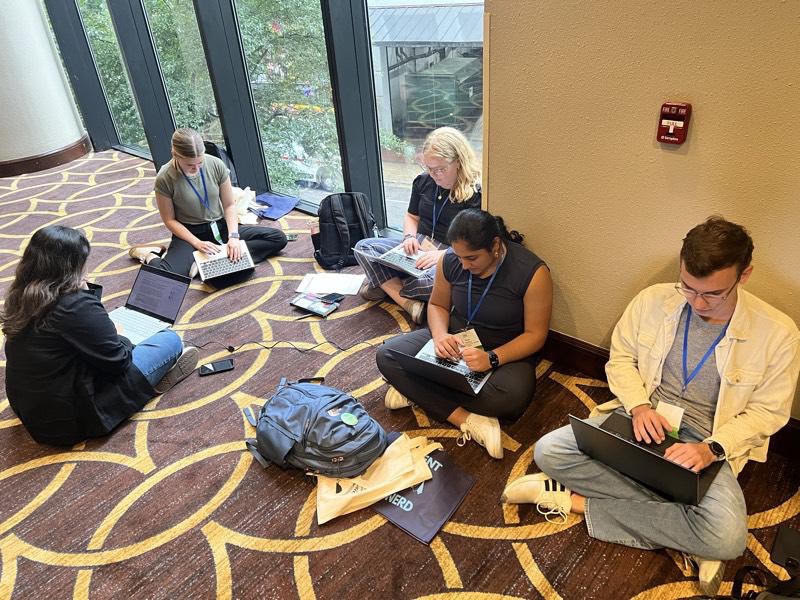
Hailey Weiner, The Hustler’s current news editor, did an internship with The Atlanta Press Club this summer and found it refreshing to have professional oversight. She said she’s one of very few students at The Hustler to have had any professional journalism experience, since only a handful of the paper’s alumni actually go into the field.
Indeed, on top of Kemp’s other responsibilities, he has to teach his younger peers how to find stories, conduct interviews and write. He learned the fundamentals of journalism through practice — and with William Zinsser’s “On Writing Well” — but he still has plenty of questions. That’s why he keeps former Echo editors-in-chief “basically on speed dial.”
Limited access to guidance made Aidan Marks feel like his college newspaper was “ill-equipped to navigate ethical dilemmas.” Davidson, a liberal arts college in North Carolina, does not offer a journalism degree, so Marks said he relied on his own research and what he learned in high school to navigate difficult choices as last year’s editor-in-chief of The Davidsonian. Marks wouldn’t necessarily have chosen to major or minor in journalism, but he would have liked to take a few classes to make him a more capable reporter and editor. He admits, however, that the staff almost always figures out the right thing to do when faced with difficult editorial decisions.
“We have had very few situations where complaints have arisen,” he said.
The “we” Marks refers to is a small contingent of motivated Davidson students. Only six or so work as staff writers under about 15 total editors, who double as contributors to the paper. Marks lamented how such a small staff has limited The Davidsonian from pursuing investigative stories and new projects; the staff doesn’t have the bandwidth for much more than the stories that will fill up a weekly print edition.
Fawcett felt the same strain, even at a paper nearly 10 times the size of The Davidsonian. The Hustler has roughly 300 students on staff, but any editor-in-chief of an independent college newspaper has an endless to-do list.
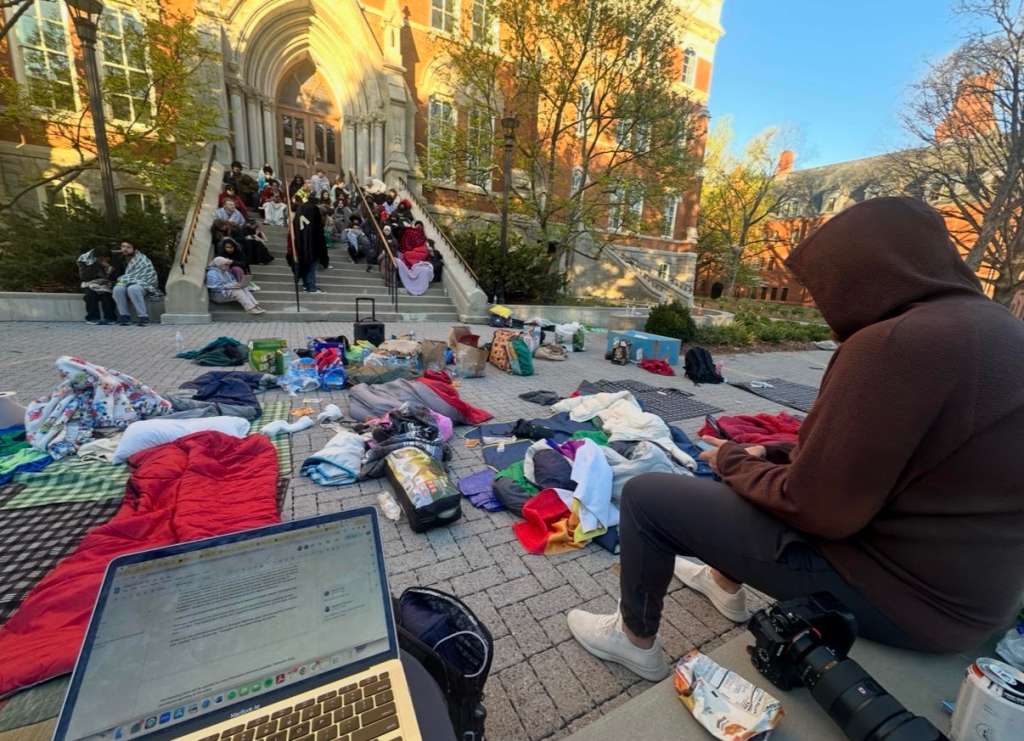
Hers was especially long, since Fawcett took over The Hustler in the spring semester of her junior year, and was thrust into the chaos of covering her peers’ pro-Palestine protests — which, at Vanderbilt, included a sit-in in an administrative building that prompted three arrests. By then, Fawcett had been working on the paper for two and a half years, so she knew what to do — but she didn’t really have time to do it. Her term at The Hustler’s helm meant “a whole lot of not sleeping.”
That, however, is a surefire way to learn. Fawcett didn’t end up pursuing a career in journalism — she works in student affairs — but her lack of a degree in the field would have signified little compared to her years of practice. Indeed, in Hustler news editor Weiner’s words, journalism is “a job that you can only learn with experience.”
For the love of the game
At Colby, Kemp usually walks back to his dorm around 11 p.m. Being editor-in-chief has its tradeoffs: The role demands hours of his time that Kemp could otherwise spend on his philosophy major, on applying to jobs or just soaking in the fun that comes with being a senior in college. He gets a small stipend each semester, but it doesn’t add up to what he’d be paid at an hourly rate at any other job. Kemp doesn’t even plan to go into journalism when he graduates in May; his commitment to The Echo comes from a deep appreciation for the work he and his colleagues do every day.
“I love seeing this product on campus every week,” Kemp said.
Nathaniel Rodwell-Simon, managing editor of The Maroon and a senior at the University of Chicago, feels similarly.
“I have really fallen in love with the process of producing good journalism,” he said.
Unlike Kemp, Rodwell-Simon does want to pursue journalism — probably. He’s keeping his options open as he’s not all that confident about the feasibility of a solid journalism career these days, but it’s nonetheless “at the top of my list.”
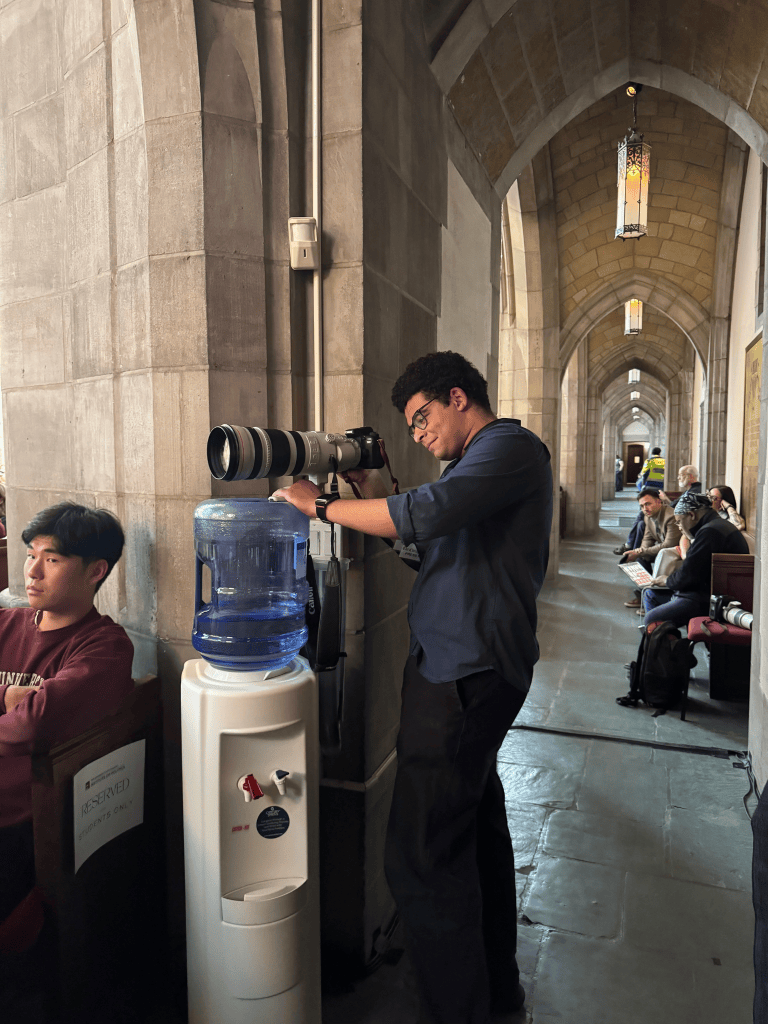
Rodwell-Simon didn’t start college with this intention, but three years at The Maroon changed that. A history and education major, Rodwell-Simon joined The Maroon as a photographer his freshman year. In the spring of 2024 — during his second semester of college — pro-Palestine encampments sprang up across college campuses, including his own. Rodwell-Simon spent 16-hour days photographing the chaos for The Maroon, until, eventually, his editors asked him to start writing updates and news stories. All of a sudden, Rodwell-Simon, with zero prior experience or interest in journalism, was a reporter.
“From the beginning, I had editors at the Maroon, including the executive editors of the paper, who I think saw something in me that I did not see in myself,” he said. “I had initially been kind of resistant to branching out from just being a photographer, but I had really, really wonderful editors who pushed me to step out of my comfort zone, to expand the breadth of what I was doing.”
Something like that might not have happened at a university with a journalism curriculum. Kemp, for example, said he probably would not have felt qualified to apply for The Echo as a freshman if he knew he would be competing with trained journalism students. The barrier to entry for papers at schools without these programs feels, inherently, a bit lower than at universities like Northwestern, Missouri or Arizona State, where the student newspapers and TV stations are dominated by journalism majors.
And a lower barrier to entry has plenty of positive effects for these student papers. For one, it allows students who don’t know about their interest in or talent for journalism to find it — like in Rodwell-Simon’s case. It also attracts a more diverse set of minds, something crucial to a news outlet with a mission to honestly reflect its community.
“It’s a positive having those folks who are not necessarily journalists by training,” Kemp said. “If the goal of The Colby Echo is to be an echo of the campus community, you have the campus community in larger numbers and more representative numbers on the Echo staff simply because there’s a lower academic barrier to entry.”
Highly motivated students find just as much to gain from joining their school papers as the organizations do from recruiting them. For one, a job at a student publication makes a nice line on a resume. There’s also a social element to most student newspapers — two years after graduation, Fawcett lives with her editor-in-chief predecessor. And then there’s something deeper:
“People here have a lot of drive, civic drive,” Weiner said. “Journalism is a career that you can … see your results kind of immediately, and how they manifest in your community. Hearing people talk about your articles, seeing (the university) make decisions based off of something that you published, doing research on something … and then bringing it to light. I think that really motivates people.”
Sophie Levenson graduated in May from Duke University, where she worked for its independent student newspaper, The Chronicle, on the sports desk. She grew up in Charleston, South Carolina, and is now a reporter for the Valley News in New Hampshire.

Leave a Reply