At the Nashville SUNN, teenagers learn it all, from story pitches to publication
By Rhea Patney
On the day she was interviewed for this story, Sarah Nipper had a call scheduled with Ruby York, a 10th grader at Martin Luther King Jr. School in Nashville. York, who DJs on Teen Power Radio Hour at WXNA, had emailed a draft of an op-ed about teen radio. Instead of sending it back covered in Google Docs comments, Nipper, a Vanderbilt senior and the editor in chief of The Nashville SUNN, planned to walk the high schooler through it.
“We’re going to talk through the developmental edits step by step instead of just commenting on them,” Nipper said. “That way, she can understand what goes into the structure of an op-ed.”
York came to the publication with a love of music but no journalism training. These editing calls have changed how she writes.
“I had no idea what I was doing when I first started writing, and it was kind of a mess,” York said. “(Nipper) completely helped teach me how to write, how to organize a piece, what to do during editing, how to make it longer and how to format it.”
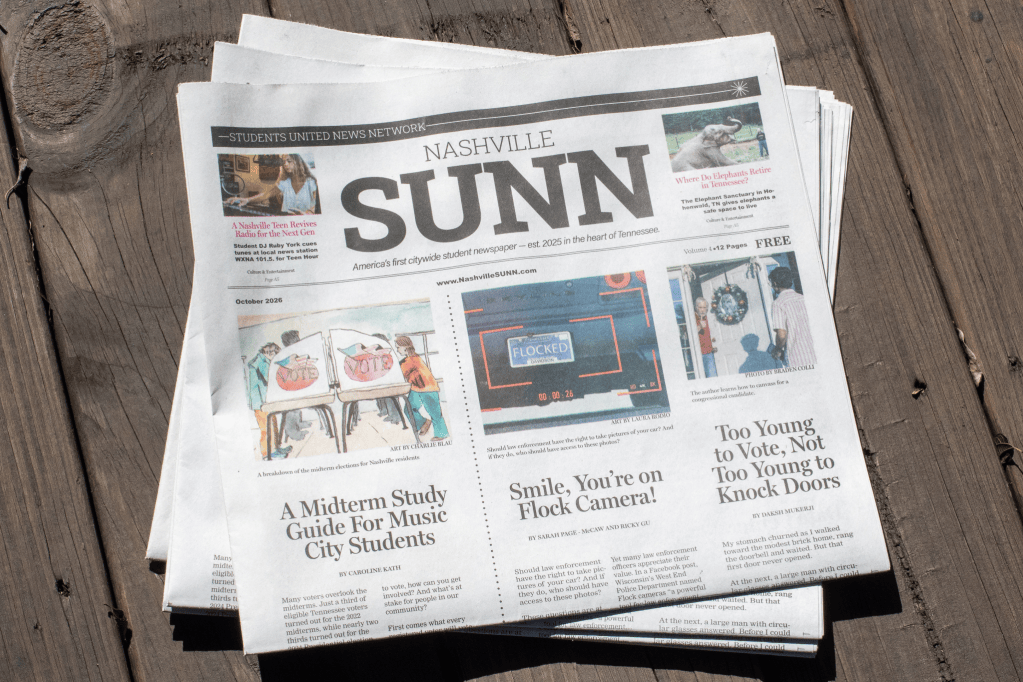
The Nashville SUNN bills itself as America’s first citywide, student-run newspaper. It launched in November 2025 with a network spanning 24 Nashville-area high schools. Most of its writers are teenagers, and its editors are all college students or recent grads.
Amanda Little, a writer-in-residence at Vanderbilt University and former Bloomberg columnist, founded the Students United News Network, or SUNN, in 2024, growing out of her work building youth civics programs. Its national publication, The SUNN Post, launched in March 2025 to showcase reporting from high school newspapers across the country. The Nashville SUNN, which works directly with student reporters across the city, is the network’s first local affiliate.
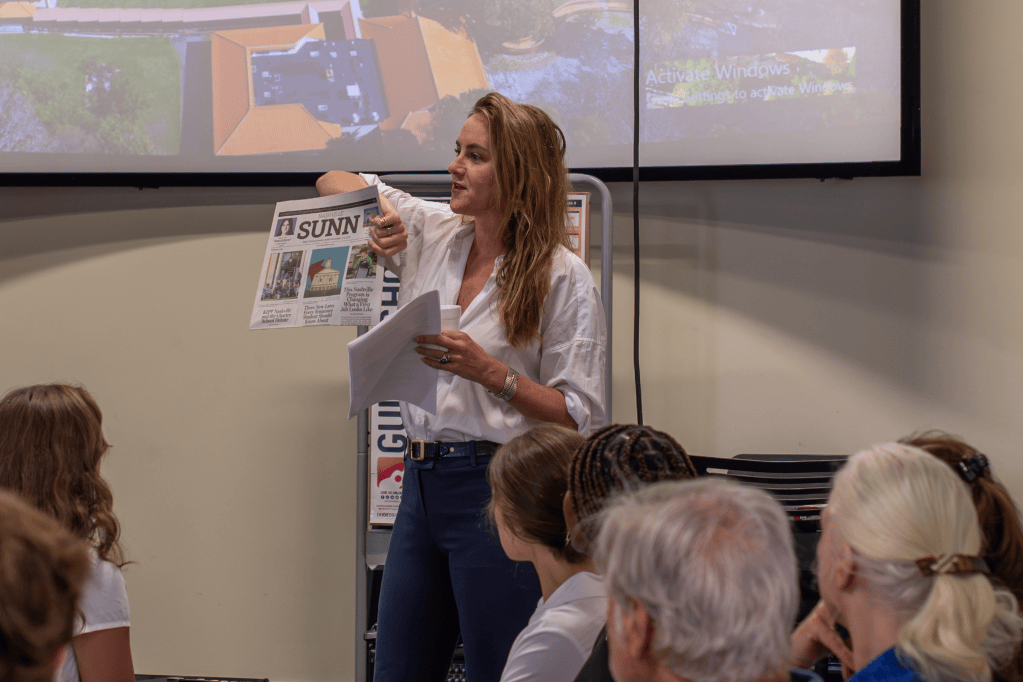
Little runs SUNN as an unpaid executive director, funded mostly by small donors and foundation grants. The organization is working to build out advertising, corporate partnerships and other consistent revenue streams.
Since May, two Vanderbilt seniors have run the Nashville paper: Nipper and managing editor Manushree Navaneethakrishnan. Five to seven Vanderbilt students also serve as copy editors and fact-checkers, and the art director is a recent graduate of Belmont University, also in Nashville. Little said the college-led structure is intentional.
“There’s no better way to motivate young talent than through college students who speak their language,” Little said. “A college student who’s doing amazing things as an undergraduate can be more exciting to the people we’re trying to reach.”
From pitch to publication
Stories come from existing high school newspapers, pitches from Nipper or Navaneethakrishnan, or, most commonly, the students themselves. About 20 writers contributed to the latest issue, the Nashville SUNN’s fourth, which officially came out Thursday. Recurring columns include Three Laws, a partnership with Tennessee’s youth governor that breaks down bills affecting students, and Thank You Mentor, where students thank a mentor.
When writers pitch their own ideas, Nipper will typically call them and workshop the idea over the phone. The writer usually has about two weeks to draft. Nipper or Navaneethakrishnan does the developmental edit. Then the copy and fact-checking desks proofread, validate sources and add necessary links. Art director Laura Rodio, the Belmont graduate, finds student artists and photographers for each piece.
The Nashville SUNN releases a new issue typically every other month during the school year. Stories, photos, op-eds, reviews and everything else the students produce run online and in print, to the tune of about 20 to 24 pieces an issue. Print copies are distributed through libraries, high schools and about 26 local businesses, some of them advertisers. About 6,000 copies are distributed, but Little is hoping to scale that up.
“The print edition is really cool, and I think it’s helping us increase community involvement. If someone has a physical copy of something, they’re going to remember it,” Nipper said. “An English teacher can show students what the SUNN is.”
The publication pays student writers between $50 and $125, depending on the assignment, and also compensates student artists and photographers. College editors are paid hourly for their work.
The Tennessean, part of the USA Today Network, also republishes some Nashville SUNN stories in a regular Sunday feature in print and online. Tennessean opinion editor Tacuma Roeback picks which pieces run. More than 20 pieces have been published so far, and the newspaper pays $50 for each article, split between the student writer and the Nashville SUNN.
Editing teenagers
Submitted pieces go through significant edits, which focus mostly on structure.
“My biggest fear isn’t that the piece won’t be good enough,” Nipper said. “It’s that they’ll be offended when I add to it or when they see all the red. The challenge is often that a student has a really unique voice and something cool to say but doesn’t understand journalistic standards or structure.”
At the end of each edit, Navaneethakrishnan writes a paragraph about the piece’s strengths.
“The first thing they’re going to think is, ‘Oh, my piece just isn’t good enough. My piece isn’t ready,’” Navaneethakrishnan said. “It’s comforting to know that someone didn’t just skim your piece. They genuinely read it and engaged with it.”
Holding the operation together across two dozen schools takes legwork. Nipper recruits by emailing English teachers and advisers across the city, including at schools with no student newspaper, and gives new writers article templates and story guidance.
“I think the biggest difficulty has been getting in contact with the high schoolers, because they’re high schoolers,” Navaneethakrishnan said. “They’re busy.”
Saturday workshops at the downtown library help. College editors and local journalists, who have included people from NPR, the Tennessean and NewsChannel 5, meet with students. The sessions are free and open to any Nashville high schooler.
Why the editors do it
Nipper sees herself in the writers.
“A big part of what I’ve liked about the job is meeting with high schoolers and walking them through the process of writing a journalistic piece step by step,” Nipper said.
Nipper also said the startup-like operation has taught her a lot about accountability. She spends 10 to 15 hours a week on the paper.
“There’s direct responsibility that I might not have in an entry-level internship. If I don’t send a text, no one else is going to do it. If I don’t send an email to get something done, it won’t get done,” Nipper said. “Honestly, my email response time is so much better now because I’ve had to learn that, which is going to be good for me after graduation.”
The Nashville SUNN gave Navaneethakrishnan an opportunity to grow as an editor. In her role as opinion editor at the Hustler, Vanderbilt’s student newspaper, she edited pieces driven by personal anecdotes, where the writer’s own voice carried the argument. But for the SUNN, she is editing far more news stories.
“Editing for Nashville SUNN was so interesting because it was so content-focused. The writers were really on top of things, fact-checking and making sure to corroborate information,” Navaneethakrishnan said. “It was … a very intellectual challenge for me, because I wasn’t just looking for the writer’s voice or personal perspective.”
Tamyra Johnson, a Vanderbilt senior who fact-checks for the SUNN, said she has valued the network the project has brought her, particularly through those Saturday workshops.
“I definitely think attending the events has been beneficial because it’s not just networking for the high schoolers,” Johnson said. “I can benefit from it, too. I met a journalist from NewsChannel 5 and we exchanged emails, and he told me to send him pieces if I want feedback.”
The power of the local model
The national SUNN Post draws on about 175 high school newspapers in 35 states, most of them established student publications. That network gives students at schools with strong journalism programs a wider audience for their work. The Nashville SUNN was designed to reach students who have fewer opportunities: those at schools with small or struggling journalism programs, or no publication at all. Its college editors help fill that gap through direct, in-person mentorship.
“Mentoring lets us work with schools that have no journalism program, newspaper, broadcast, podcast or anything else. We can bring in students interested in debate, Model UN, youth in government or student council, or students who simply care about issues and want to amplify their voices,” founder Little said. “There are many ways to bring in students with tremendous potential as storytellers and journalists, even at schools without newspapers that we can’t currently reach through the national model.”
That mentorship also shapes the college students doing the editing. On Saturdays at the library, Navaneethakrishnan shares lessons from her own path through college journalism with high schoolers just beginning theirs. The work gives her a chance to pass along guidance, while helping students build skills they can carry into any field.
“You don’t have to want to be a journalist to do journalism,” Navaneethakrishnan said. “Genuinely, every single field can benefit from it because you’re having conversations with people. I owe so much to the SUNN — it truly is a facet of my identity and personality and has advanced my leadership in so many ways.”
Rhea Patney is a master’s student at Johns Hopkins University and a freelance journalist based in Baltimore. She graduated from Vanderbilt University, where she served as managing editor of the student newspaper, The Vanderbilt Hustler, working primarily on the news and sports desks.

Leave a Reply