Experts say universities purposely deny, redact and stonewall student journalists’ public records requests

By Miranda Morgan
The 1966 Freedom of Information Act was meant to combat governmental secrecy and ease access to public or “open” records for citizens.
Journalists in particular use FOIA and state open records laws to watchdog the government, investigate government claims and provide fact-checks and context for audiences.
But they often face barriers to information access: resistance on the part of government agencies, chronic understaffing among records custodians, and redactions that render their records toothless or nonexistent.
Collegiate journalists bear additional burdens, such as balancing classes and student media jobs; navigating the barriers imposed by FERPA, a federal law designed to protect the privacy of educational records; and the awareness that they’re only covering campus for a few years until they graduate.
For student reporters, making open records requests at their public universities can feel like an exercise in futility.
At Western Washington University, students waited years for their records request to be fulfilled — long after their time at the university had come to an end, and only after a lengthy legal battle.
Julia Furukawa, Asia Fields and Erasmus Baxter took on WWU when their records requests for campus sexual assaults were repeatedly delayed before eventually being denied, leading the students to file a lawsuit against their university.
Furukawa, who now works as the host of “All Things Considered” at New Hampshire Public Radio, was the editor-in-chief at The Western Front (now just The Front) when the fight for the records started.
“Don’t let bureaucracy or administrative lingo or slow responses tell you that it isn’t going anywhere, because if you are on the ball, it will force others to be, too,” Furukawa said.
When the records were finally handed over five years later, the students had long moved on from their university and pursued their own professional careers; the information had been rendered useless to the trio. What did stand, however, was the precedent they set for future WWU journalists.
“This lawsuit was never about the money,” Baxter said in a 2025 press release. “It was about forcing Western to follow the law. We hope this settlement … will provide an example and resources for future students so that they can hold powerful institutions accountable — even if the institution is their own university.”
Furukawa, Fields and Baxter used the $42,000 that was left from the original $111,780 (after attorney fees, taxes and expenses) to create an endowment at their alma mater: the Student Investigative Journalism Fund.
Mike Hiestand, senior legal counsel at the Student Press Law Center, said universities know that requesting records takes time — time that students do not always have as they move toward graduation. It is just one of the tools that officials use to keep records behind closed doors.
They also put up financial barriers, which can be a serious issue for student journalists looking to pursue pieces that need records.
“There is a weaponization of fees,” Hiestand said. “(Universities) know that if they charge, say, $1,500 for the document and all the work that goes into producing it, student newsrooms can’t always pay that.”
FERPA precautions and over-redactions
Slow response times and expensive price tags are not the only barriers. When agencies or universities choose to be overly cautious and opt for the redaction route, the responses to requests can feel like a blockade in themselves.
When student journalists from The Louisville Cardinal at the University of Louisville in Kentucky got a specific crime record back, it was essentially a black box.
“When we request records from the university … often, those records are over-redacted,” said Vinny Porco, editor-in-chief of The Louisville Cardinal. “Granted, there are certainly things in those records that need to be redacted, especially depending on the timeliness with which we request them. However, we have gotten entire documents of just black, highlighted lines.”
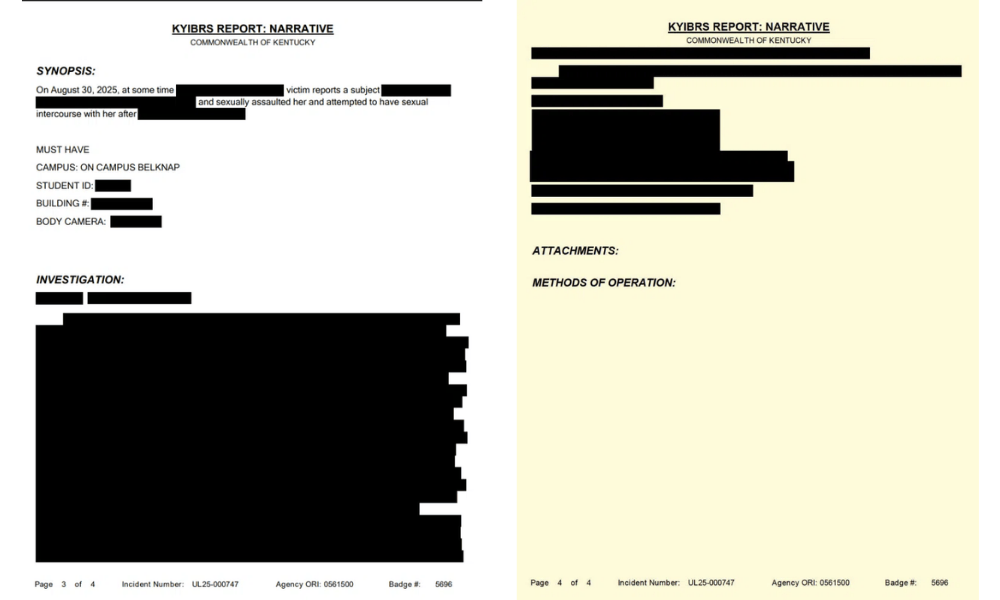
Redacted incident reports of an on-campus rape that reportedly occurred on Aug. 30, 2025, at the University of Louisville in Kentucky. (Images courtesy of The Louisville Cardinal)
One expert said he believes that some colleges attempt to wait out their students’ time on campus, hoping that graduation or financial insecurity will render the records requests useless to those who originally sought them.
“I think a lot of officials at universities, particularly public universities, have figured out they can just ignore requests and delay student journalists and get away with it. They know that students are less likely to hire an attorney,” said David Cuillier, director of the Brechner Center for Freedom of Information at the University of Florida. “They don’t have a lot of money. They don’t have a lot of time. (Administrators) know in May or June, (students are) gonna head out for summer and forget about things … their class will end, or they’ll graduate, and so they just wait them out.”
SPLC’s Hiestand confirmed.
“I know for a fact it is one of the tactics,” he said. “I have talked to school officials who will say, ‘We can outlast (the students).’”
The complications of obtaining records are only heightened by the nuances of state law specificities and FERPA.
For instance, in the case of sexual assault records, a student journalist might expect the names of victims to be redacted. However, the names of perpetrators, some aspects of the crimes and the punishments doled out are considered details that the colleges or universities are permitted to make public.
“FERPA has been warped and misinterpreted … it has become a convenient all-purpose excuse to deny records that they don’t want people to have access to,” Hiestand said.
States vs. students
Open records laws are state-specific. Some states have open-ended response and fulfillment deadlines, while others have a specific number of business days to fulfill requests. Some states also allow for extensions.
In a recent piece for Poynter and the Student Press Report, former University of Massachusetts Boston student journalist Josh Levin wrote about his exhausting pursuit of records in which officials used legal extensions to drag out his requests for months.
Noncompliance punishments also vary by state. Some states threaten fines and even jail time under certain circumstances for willful violations of state open records laws.
Kentucky has had numerous records disputes between universities and students. When the state attorney general’s office sided with student journalists at the University of Kentucky, the university took it upon itself to sue its own students. Western Kentucky University similarly sued its students to avoid handing over records of employee sexual misconduct.
Mike Abate, one of the attorneys who represented WKU’s College Heights Herald student newspaper, said you would think universities, in the pursuit of truth, would turn records over.
“But it’s the opposite,” he said. “I think they are utterly paranoid about their reputation and perception. Those investigations revealed a really troubling pattern of institutions trying to sweep these serious allegations under the rug.”
Triumphs and setbacks
Redactions and lengthy delays threaten community reporting for all journalists, and especially student journalists, but some college reporters have it worse: Community college students have even more limited time — often just two years on campus.
The Citizen, a community college newsroom at Laney College in Oakland, California, repeatedly requested documents regarding its district’s overhaul of new security policies following the 2020 murder of George Floyd. In 2023, they sued the Peralta Community College District for the records.
The Citizen’s student journalists uncovered plans for the district to pay millions of dollars to security companies that were unlicensed in California. Additionally, they brought attention to the fact that the executive director of public safety for the Peralta Community College District was facing misdemeanor criminal charges.
In turn, they were subjected to criticism from district leaders, such as Siri Brown, vice chancellor of academic affairs and support services at Peralta, who said “the way the ‘Citizen’ has handled this entire safety project is in my view racists [sic] and completely unacceptable.”
While the journalists were eventually provided with the records they requested, they were also left with frustration.
“Getting some of this public information took nearly three years – longer than it takes to receive an associate’s degree at PCCD, and much longer than the legally required 10 days,” said Li Khan, 2024 editor-in-chief, in her article reflecting on the legal battle. “By the time we signed a settlement agreement, all four of the student journalists named as plaintiffs in the lawsuit had moved on from The Citizen.”
Ken Lester, managing editor for The Citizen during the lawsuit, said, “I think we knew it was going to take too long for it to really help us out as much as it would hopefully help future students.”
Similarly to Furukawa, he said he felt that the precedent their endeavors set would be the most rewarding part of the struggle. “(Students) don’t have to just accept the fact that (the college) is not going to give you the records that they’re required to give.”
The investigations earned The Citizen the 2023 Student Freedom of Information Award from the Student Press Law Center. In SPLC’s press release regarding the award, executive director Gary Green said, “Often, there is no one other than student media to hold college administrators to account. Citizen adviser Eleni Economides Gastis and her student journalists have shown the local community, and those in power, they are watching.”
What price freedom of information?
Despite these newsrooms triumphing, experiences with public records requests like The Citizen’s can take a toll.
“You see it through rose-tinted glasses and you’re like, ‘Oh, I’m going to tell the truth. I’m going to find the truth.’ Then, you run into these systems that prevent you from doing that,” Lester said. “It’s draining when you know that there’s a story, you know the truth and you have enough evidence for yourself to know that something is true, but (you’re) not able to find enough evidence to push it past the line of being able to feel comfortable publishing it.”
Encounters like Lester’s point to the importance of a functioning FOIA system, not only for the public, but for students studying journalism as well.
“At the end of the day, you’re suing the school that you’re going to. It’s not a cool, fun thing to have to do,” said Lester, who has since halted his journalistic endeavors in favor of public relations work for local sports teams.

Miranda Morgan is a student at Chaffey College in Rancho Cucamonga, California. She has been the editor-in-chief of the school’s student-run publication, The Breeze, since January and is a fellow with the Solutions Journalism Network. She will graduate from Chaffey in December with an associate degree for transfer in journalism and hopes to continue reporting on features, culture and news.

Leave a Reply